

Autistic Mental Wellbeing Approach
What is the Autistic Mental Wellbeing Approach?
In addition to other mental health interventions, we use the Autistic Mental Wellbeing approach for autistic young people with mental health difficulties. The approach can be useful as a complement to other mental health approaches, as it provides a framework to consider changes and adaptations to the environment, that in turn help to reduce situations that autistic young people may find distressing.
AIMS
Autistic Mental Wellbeing aims to:
Reduce anxiety and stress for the young person and their family, by looking at environmental adaptations, and changes to the way others communicate with the young person
Enhance positive emotional wellbeing and quality of life for the young person and their family
Provide skills to help the young person meet their needs (this is also reflected in adapted CBT work)
Give families and the wider system skills and strategies to support the young person
In CAMHS, we celebrate the young person’s neurodiversity. We believe in altering the environment and people’s responses, to meet the young person’s needs; to support their individuality and enhance their wellbeing.
The approach is based on best practice guidelines for autism, neuro-affirmative approaches which value the autistic person’s experience, and feedback from young people and their families. The Autistic Mental Wellbeing approach in CAMHS compliments other mental health interventions as is appropriate and provides the foundation for other support.
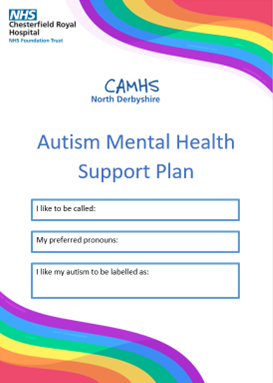
We will meet with the young person to complete an Autism Mental Health Support Plan. The young person can do this on their own or they may want their parent/carer to be present. If a young person is not willing or able to take part in the work, the approach can be completed with their parent/carer instead.
During the sessions, we will ask questions about the young person’s skills, strengths, and difficulties so that we can fully understand their lived experience. We may use questionnaires to guide us or play video clips to help us explain ideas and concepts.
We will consider emotional arousal and emotion regulation. We will use an emotional arousal curve to understand the experience of distress in the young person. We will offer ideas support the young person when they are distressed, and to reduce the chances of the young person becoming distressed. We may ask young people and parent/carers to practice ideas and techniques.
The aim of the Autism Mental Health Support Plan is to help other people understand the young person’s neurodiversity and improve their quality of life. It can be shared with anyone who supports the young person, like wider family members, school or a sport’s club.